The Judge Poché Plantation House in Convent was the first River Parishes plantation I visited. Often referred to simply as Poché Plantation, the house was built around 1870 and belongs to the postwar era rather than the antebellum period, though the land had previously been part of a large sugar-cane plantation.
The house stands out for its unusual pink color and dormered roofline. Today it sits in the middle of an RV park and operates as a bed-and-breakfast. Tours are available by appointment, so I scheduled one in advance.

The Law Office That Came First
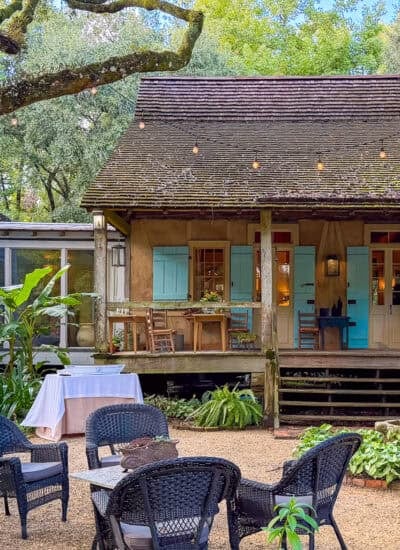
One of the first buildings pointed out during my tour wasn’t the big house itself but the smaller structure beside it. It served as Felix Pierre Poché’s law office and family home while the main house was being built.
It was here that Poché began the legal career that would eventually make him one of the most influential lawyers in Louisiana.

Felix Pierre Poché

Felix Pierre Poché was a Louisiana lawyer who later became an associate justice of the Louisiana Supreme Court.
In 1876, while attending a meeting of lawyers in Saratoga Springs, New York, Poché proposed creating a national organization for attorneys. Two years later, that idea led to the founding of the American Bar Association.
He also kept a Civil War diary written in French that was later translated and published. Historians still reference it when studying Confederate activity in Louisiana.
From 1880 to 1890 he served on the state’s highest court during a period when Louisiana was redefining its legal system after the Civil War and Reconstruction. He also participated in the convention that drafted Louisiana’s 1879 Constitution, which reorganized the judiciary.

Inside the House
The tour includes all of the first-floor rooms. The second floor is used for guest accommodations. Most of the period furnishings were purchased at estate sales by the current owner.


Rolling the House Back

One of the most unusual chapters in the house’s history happened decades after Judge Poché lived here. In 1896, the Himel family purchased the property. After the 1927 Mississippi River flood and the levee expansion that followed, the house had to be relocated to allow enlargement of the Mississippi River levee.
Around 1929 the structure was moved back several hundred feet. Workers lifted the house onto large logs and slowly rolled it to its current location. One of the fireplace mantels still shows a crack from the move. The dormers that define the roofline today were added during that relocation and renovation.

Final Thoughts
The pink exterior didn’t really win me over. I would have loved to see the house in its original white instead, and the period furnishings inside were fairly typical. The arched gallery and dormer details are interesting from an architectural standpoint, but what stuck with me most were two details from the tour.
First, the house was moved about 300 feet in 1929, rolled on logs to make room for levee expansion along the Mississippi. Second, Judge Felix Poché, who built the home, went on to help launch what became the American Bar Association. Those pieces of history ended up being the most memorable parts of the visit.








Leave A Reply!