Auburn, New York, is home to several important historic sites connected to Harriet Tubman’s life after she found freedom. Each site offers a different perspective, revealing Tubman not only as a freedom seeker, but also as a neighbor, landowner, caregiver, and community leader.
Here are the places that brought that story together.

Seward House Museum: The Move to Auburn
33 South Street, Auburn, NY
Hours & Info

When I visited the Seward House Museum, I found one of the clearest links between Harriet Tubman and the life she built in Auburn. Frances Seward’s antislavery and women’s rights work brought Tubman into the Seward family’s orbit, and in 1859, Tubman purchased seven acres of land from the family.
A basement exhibit, Forged in Freedom: The Bond of the Seward–Tubman Families, looks at how the two families worked together and highlights Tubman’s time in the house, including the period when her daughter stayed with the Sewards.
Upstairs, the guided tour zooms out to the bigger picture of the Seward family, which I wrote about in detail in my full guide to the Seward House Museum.

Harriet Tubman Residence: Home and Haven
180 South Street, Auburn, NY
National Historical Site Info

The guided tour at the Harriet Tubman Home traces her life from childhood through her years in Auburn, using a fast-paced storytelling style. It begins with her early life as Araminta “Minty” Ross in Maryland, including the violence she endured and the head injury that caused lifelong seizures.
I’d explored this part of her story before while visiting the Harriet Tubman Underground Railroad Visitor Center in Maryland, but hearing it again (and in a new way) here helped frame everything that came next.

The tour continued with her escape to freedom, her work on the Underground Railroad, her Civil War service, and finally her life in Auburn, where she established the Harriet Tubman Home for the Aged. After the tour, I was able to walk through the Home for the Aged and see her brick house on the property.

Thompson Memorial AME Zion Church: Her Spiritual Home
47 Parker Street, Auburn, NY
Hours & Info

Next, I went to the Thompson Memorial AME Zion Church, where Harriet Tubman worshiped. I started in the parsonage next door, which now houses the site’s exhibits. The informational panels focus on the network that supported her, including the New Guinea Free Black settlement that welcomed her into the community.
Then I went inside the church itself, where Harriet attended services. A ranger shared that she sat in the front row and sometimes fell asleep. This was also where her funeral was held, and the interior has been restored as closely as possible to that period. After her death, the church continued as an active congregation for decades.

Fort Hill Cemetery: A Quiet Place of Honor
19 Fort Street, Auburn, NY

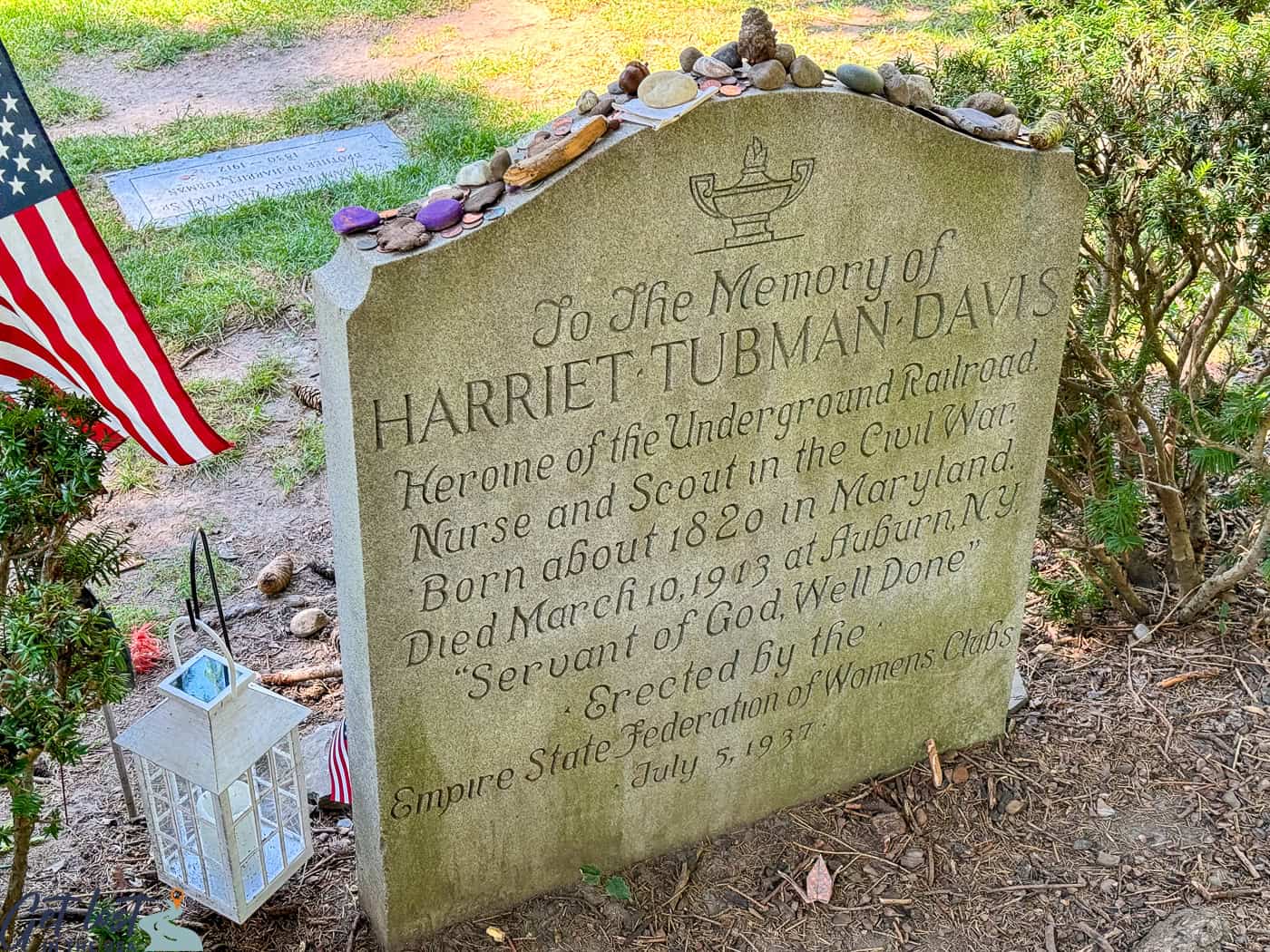
Fort Hill Cemetery is where Harriet Tubman’s Auburn story comes to rest. She died in 1913 and is buried here beneath an evergreen tree planted by her great-niece and nephew.
It was touching to see the many items left by visitors, including stones, pinecones, and pennies. A lantern sat beside the gravestone as well, a detail that felt fitting given Tubman’s life.
Equal Rights Heritage Center: A Modern Tribute
25 South Street, Auburn, NY
Hours & Info

The Equal Rights Heritage Center is a modern museum in downtown Auburn, marked by a large bronze statue of Harriet Tubman out front. Inside, the exhibits place her within a broader story of abolition, civil rights, and women’s rights, connecting her work to other reformers and movements and tracing how struggles for freedom, equality, and the right to vote overlapped over time.
After visiting places tied directly to Tubman’s daily life, this stop made me think more about how her legacy still shows up today.

Seeing Auburn Through Harriet’s Eyes
Exploring Auburn, New York, with Harriet Tubman in mind changed how I experienced the city. Each stop added context, from the land that anchored her in Auburn to the home, church, and institutions she helped build. Seeing these places together offered a fuller picture of who she was and why this part of her story matters.








Leave A Reply!