I spent a couple of days exploring historic spots in Fairfield, Iowa, and it turned into a much more interesting tour than I expected. Draft horses, early inventors, a Carnegie museum packed with local lore and oddities, a Freedom Rock, and the influence of Maharishi International University.
If you want to see what makes Fairfield’s historic attractions fun, weird, and worth a closer look, I’ve got you covered.

Visit Fairfield Iowa hosted my stay. Everything I’ve shared is my own take on what I experienced.
Fairfield History Highlights
In a hurry? Here’s the TL;DR list of Fairfield, Iowa’s historic attractions, with links to each section below. Or keep reading for all the details!
Maasdam Barns

From the road, the Maasdam Barns look like a simple cluster of old farm buildings, but they actually shape a much bigger story, one that influenced the nation’s agricultural industry.
Jacob Maasdam built a thriving draft horse business by importing and breeding Belgian and Percheron horses. They stood larger than standard horses and moved quicker than oxen, so farmers snapped them up as agriculture modernized and railroads made it easier to bring new equipment into the region.
To get a feel for their size, I stood next to a life-size cutout of Louis d’Or, a Belgian stallion once billed as the world’s largest horse. I tried to boop his nose, but couldn’t even get close.

Maasdam’s draft horses weren’t the only big idea coming out of Fairfield at the time. Joel Turney started Turney Wagon Works. By the turn of the century, his business was selling between 5,000 and 6,000 wagons a year.
They offered two models: the Charter Oak, a premium line with a spring seat, and the more utilitarian Fairfield wagon, built to haul freight.

Another Fairfield innovator was William Louden. He patented a hay carrier and overhead trolley system that made two-story barns practical for everyday farm work.

He went on to design barn door hangers, livestock watering systems, and manure carriers, and to file around 200 patent applications. His trolley system later helped inspire the early development of factory monorails.
Louden was fiercely protective of his patents, so his name ended up stamped on just about everything he made. One thing that cracked me up is that his gear has a huge fan base. There’s even a website called Hay Trolley Heaven where collectors geek out on it.
There are three barns on the property: the show barn, mare barn and stallion barn. Inside the barns I saw some of Louden’s pulley-driven inventions up close.


Maasdam Barns is open Saturdays from May through November, with tours available by appointment the rest of the year. They also host special events, including Baby Animal Days each spring, as well as draft-horse and riding demos.

Carnegie Historical Museum

Fairfield’s Carnegie Historical Museum turned out to be a lot more interesting than I expected. I highly recommend taking a guided tour. The museum is full of things to see, and the museum’s director knows all the stories behind each exhibit.
The building itself is a piece of history because it’s the first Carnegie-endowed library west of the Mississippi. When it opened, the Smithsonian sent crates of artifacts to help fill the shelves, including Zuni whistle jars that mimic bird calls (ask for a demo!) and a very rat-looking taxidermy mountain lion.

The museum also leans into local history. I spotted Fairfield firsts like the 1910 Orpheum movie projector and the city’s first breathalyzer, which sent breath samples to Des Moines for analysis. Imagine waiting for test results through the postal system.

I also learned that the Fairfield Glove Factory once sent gloves with Admiral Byrd to the South Pole, and the museum even has his certificate of thanks.
Also, there’s Harper Brush, which started with a Parsons College student trying to help his mom clean chandeliers and eventually grew into a company that lasted more than a century.
Plus, Louden pops up again, echoing what I’d just learned at Maasdam Barns.

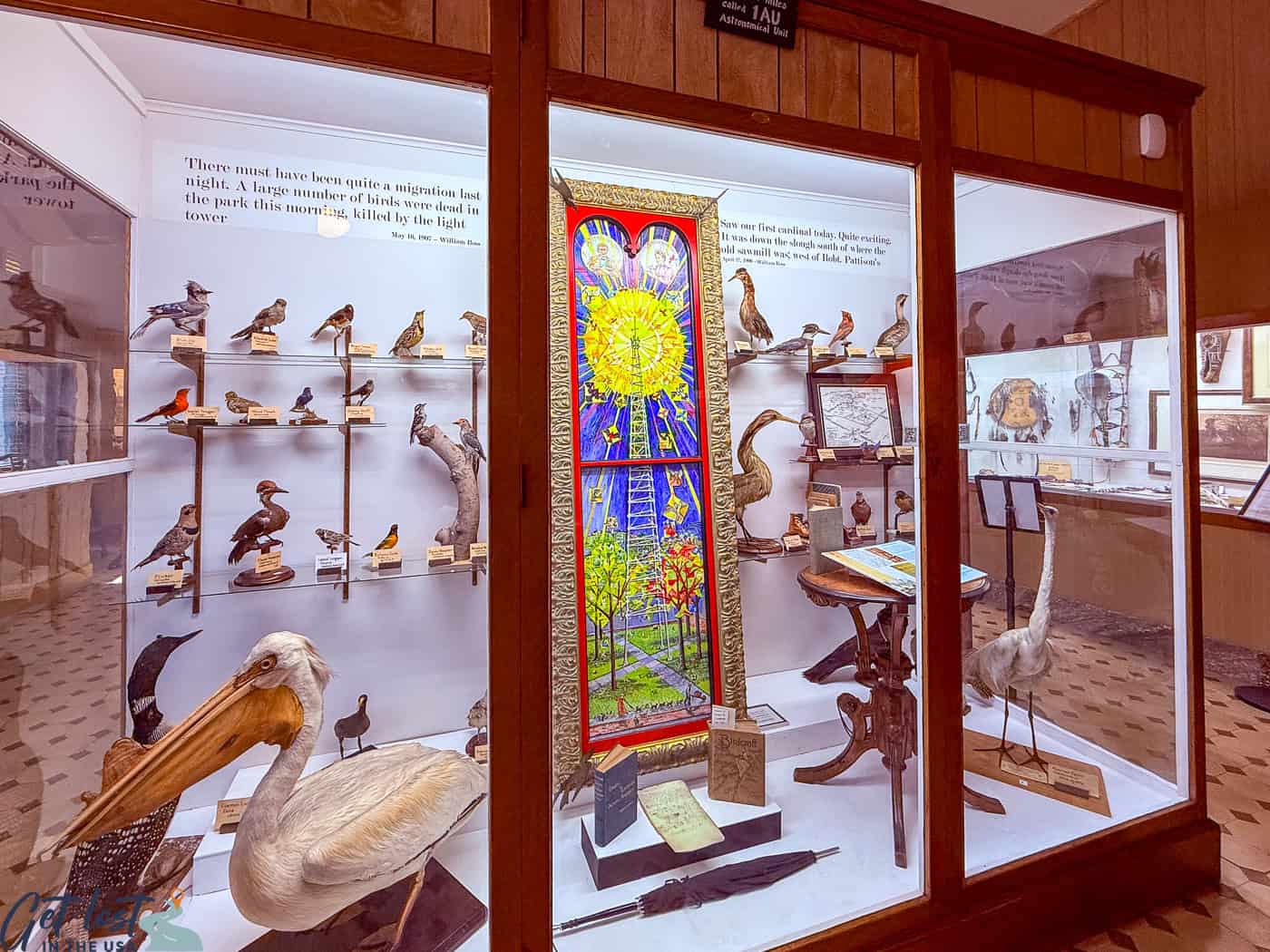
And then there are the quirky exhibits… The town once built a 180-foot light tower that shone so brightly that migrating birds flew into it at night. Locals documented every species they found on the ground, and the museum now displays mounted specimens that represent those discoveries. Bizarre, right?
The Carnegie Historical Museum is a must-see!
Jefferson County Courthouse and Freedom Rock

The Jefferson County Courthouse is one of the most eye-catching courthouses I’ve come across. The contrast between the sandstone base and the dark red pressed brick above it really pops, especially against a bright blue sky.
And that clock tower is a beauty. Its steeple came down after storm damage in the late 1940s and was finally restored in 2004. The building is on the National Register of Historic Places and is a standout landmark in Fairfield.

Right on the courthouse lawn sits Fairfield’s Freedom Rock, part of the Iowa project that honors local heroes with hand-painted murals. In Fairfield, one side belongs to Major Mehitable “Auntie” Woods, a Civil War nurse who hauled wagonloads of supplies, sometimes 30 tons at a time, to care for Iowa soldiers as far south as New Orleans.
She had the kind of grit that deserves a whole mural. She was so respected that she was commissioned as a Major, and Fairfield even named its fire company after her.
I love that the rock sits right in the middle of town, and I’d love to see a little history panel added someday so people can learn the stories hidden in the artwork.

Bonnifield Cabin

The Bonnifield Cabin holds a special place in Iowa history as the oldest existing two-story log house in the state. Its logs were hand-hewn with a broad axe, the roof was covered with walnut shingles, and the fireplace was built from stone quarried nearby.
It’s also a house with a story. In March of 1839, Fairfield itself got its name inside the Bonnifield home, which at the time sat out on the prairie with nothing else around.
When townsfolk gathered at the cabin to choose what to call their new community, it was Mrs. Bonnifield who suggested “Fairfield,” inspired by the beauty of the surrounding landscape. Everyone agreed, and the name stuck. Not a bad legacy for a living room conversation.

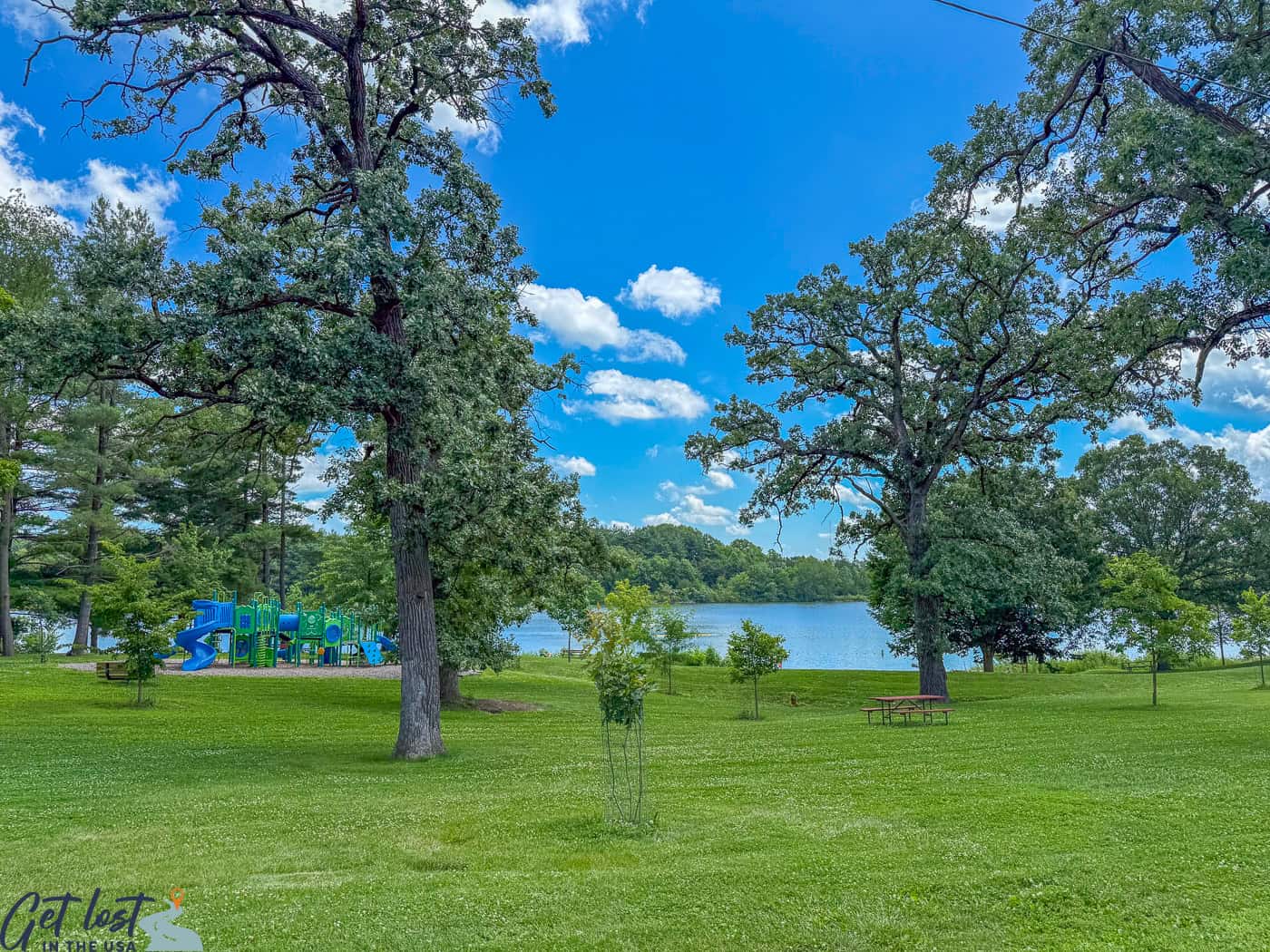
The home is on the National Register of Historic Places and sits on a ten-acre tract called Old Settlers Park. The park connects to Waterworks Park on Bonnifield Lake, where there’s a beach, walking trail, playground, and picnic area.
First Iowa State Fair Marker
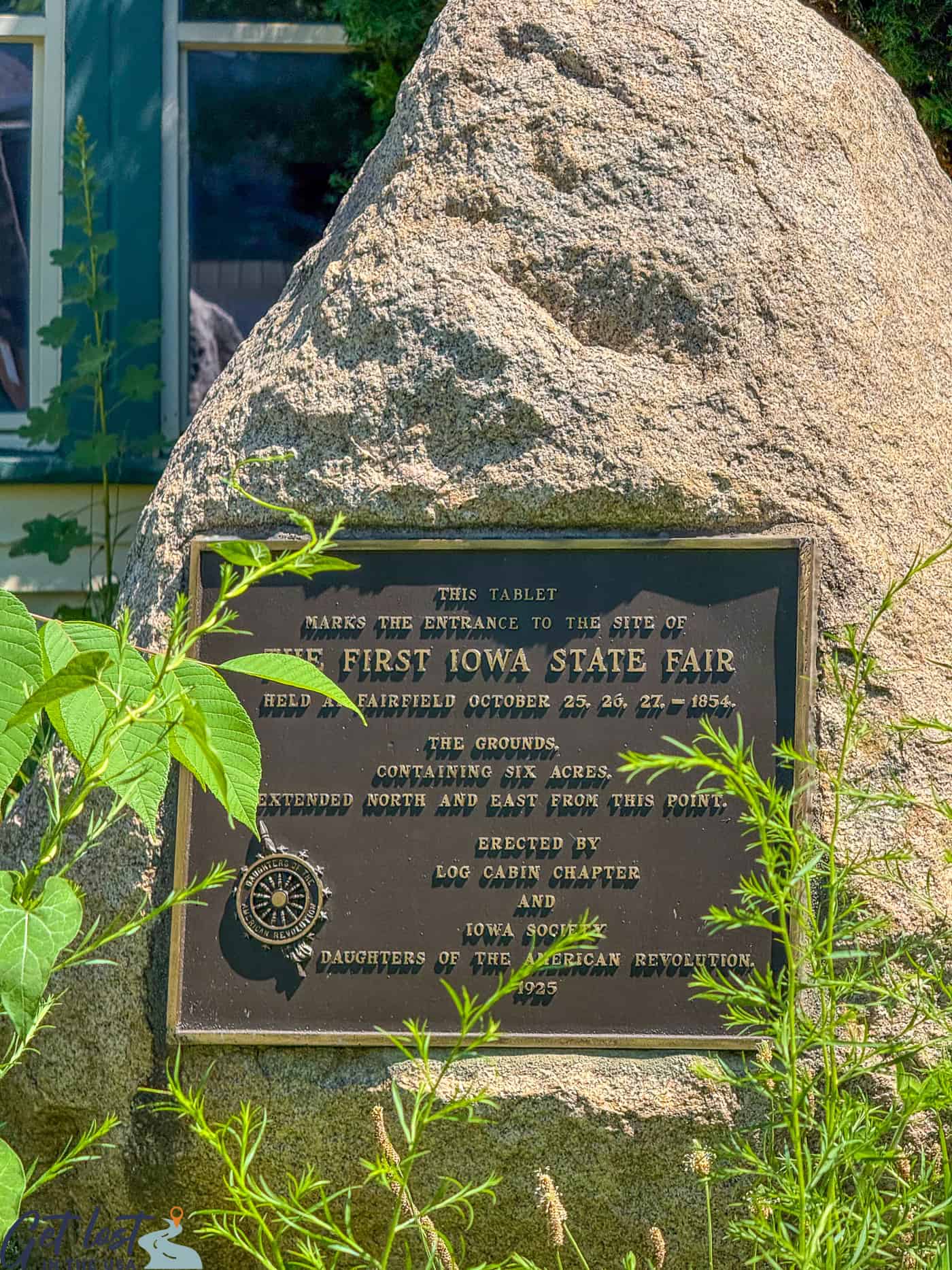
This is where Iowa’s very first State Fair was held back in October 1854. Fairfield also hosted the second fair in 1855 before the event started moving around the state and eventually settled for good in Des Moines.
If I hadn’t known to look for the marker, I probably would have missed it, even though it’s a pretty big rock. It sits in someone’s front yard and is half hidden behind weeds. It’s a very low-key spot for such a big piece of Iowa history.
Fairfield’s Historic Buildings That Still Turn Heads

I found some striking architecture around the square, which, fun fact, used to be a circle. Back in 1902, when the streets were first paved with brick, the circle was squared off.
The first building that grabbed my attention was the brightly painted Thoma Building, which struck me as delightfully gaudy. It’s one of the few Fairfield storefronts that still looks much like it did in the 19th century.
Across the square, a Queen Anne–style building stood out with its turret and mix of details.

And when I was leaving town, I spotted the James A. Beck House, one of Fairfield’s most well-known homes. This Queen Anne has a three-story corner tower and a wide wraparound porch, and I liked it so much I pulled a U-ey to snap a pic.
If you’re a real architecture buff, the Fairfield Heritage Tour site has plenty more stops and stories. Search “Fairfield Iowa Heritage Tour,” and it should pop right up.

Maharishi Vedic Observatory

The Maharishi Vedic Observatory is an open-air collection of masonry sundials arranged to show the movements of the sun, planets, and stars. Observatories like this once appeared in cultures around the world, from Stonehenge to Machu Picchu, and walking through this one gives you a small sense of how people once studied the sky using shadows, angles, and light.
I’m sure someone more familiar with Maharishi International University and Transcendental Meditation could explain it in deeper detail, but as a visitor, I found it to be a calm, thoughtful spot to wander, and I appreciated not having to do any math to enjoy it.

MIU is also a major contributor to Fairfield’s unique character. After Parsons College closed in 1973, MIU moved onto the campus and brought with it a philosophy centered on TM and what it calls consciousness-based education. Students practice TM as part of daily life, pairing traditional coursework with an emphasis on personal well-being.

Final Thoughts
Fairfield’s historic spots paint a picture of a place that has always been inventive and a little unexpected. From barns and museums to log cabins and courthouse art, there’s plenty here for curious wanderers. If you like your history with a few quirks and good stories, Fairfield, Iowa, is a fun destination to explore.





Leave A Reply!