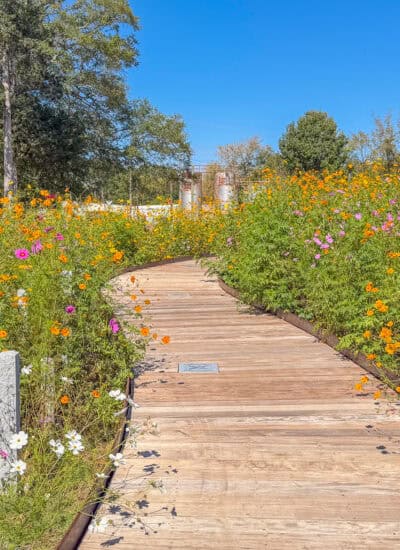
When I visited Mulberry Street Cemetery in LaGrange, Georgia, the wildflowers along the new boardwalk caught my attention first, but I wasn’t there for the scenery. I came to learn about Horace King and the history of the unmarked graves.

Cemetery Origins

The cemetery stayed in use from about 1863 through 1930. During the Civil War, LaGrange served as a treatment stop for wounded Confederate soldiers brought in by train. Local churches and schools functioned as hospitals, and the town buried the soldiers who died after arrival, even though most weren’t from the area. Today, about 300 Confederate soldiers lie in the oldest section of the cemetery.

The Unmarked Graves

A large portion of the cemetery includes more than 1,000 unmarked graves, a fact that went unknown for many years. Most of these belong to African Americans, including formerly enslaved people and their descendants. Inconsistent record-keeping around these deaths left very little usable information for identification.

Instead of headstones, there are small markers set flush with the ground or stone pillars documenting burial locations. The Troup County Archives is still looking for information from anyone who might know someone buried here.

Horace King and the Bridge

After walking through the unmarked sections, I headed to Horace King’s burial site. King was born enslaved, trained under John Godwin, and eventually gained his freedom before building more than 125 bridges across Georgia and Alabama. He is buried here alongside his son, Marshall.

Just beyond his grave stands a piece of his legacy. The Wehadkee Creek Covered Bridge was constructed in 1873 and originally spanned a creek in Troup County. Crews moved it in the 1960s to Callaway Gardens to save it from the development of West Point Lake, and it remained there until it was eventually dismantled and reassembled here.
Walking through it, I could still see the original construction markings, wooden pegs, and the lattice truss system that made King’s bridges so durable.


Walking the Site Today

The entrance features a large kiosk with photographs and history, leading to a boardwalk that lets you move through the site without disturbing the graves. You can see burial markers where the boardwalk crosses them, and pillars peek out from the wildflowers along the path.

There are also concrete walkways with interpretive panels and a small garden honoring the sextons who cared for the grounds over the decades.

Final Thoughts
Mulberry Street Cemetery isn’t a single story; it’s a place with overlapping layers of history. I appreciated seeing how Horace King’s legacy and the stories of the unmarked graves are tied to LaGrange. Being there in person made the history easier to understand, much like my visits to Arlington National Cemetery and the Harriet Tubman sites in Auburn, NY.
Recommended Reading I found these two books to be the most cited resources for anyone wanting to understand more of King’s work and history:
- Bridging Deep South Rivers: This is the definitive biography of Horace King. It covers his transition from slavery to becoming a prominent entrepreneur and legislator.
- Horace King: Bridges to Freedom:This is a well-regarded historical account that focuses on his specific construction projects. It’s a good choice if you want to know more about the “town lattice” design of the bridge.
Know Before You Go
- Address: 101 West Mulberry Street, LaGrange, Georgia (adjacent to the Thread Trail)
- Parking: On-site parking lot
- Hours: Open during daylight hours
- Time: Plan on 30–45 minutes to read the panels and walk the bridge
- Accessibility: The main boardwalk is flat, though some grassy areas are uneven
- Website: https://mulberrystreetcemetery.org/
More Horace King Sites in LaGrange, Georgia

If you’re interested in seeing more of Horace King’s work around town, I also found:
- Horace King’s Home: 508 Greenville St. (Private residence, but visible from the street)
- Lafayette Square: Look for the historic commercial buildings on the east and north sides of the square.
- Legacy Museum on Main:136 Main Street. Exhibits on his life and engineering.
- Video Overview: The City of LaGrange has a short video featuring Shannon Gavin Johnson from the Legacy Museum. It covers King’s bridge-building techniques and his time in the Alabama legislature.
- Downtown Electrical Box: Located near the square, featuring a portrait of King and a QR code for more history.







Leave A Reply!